
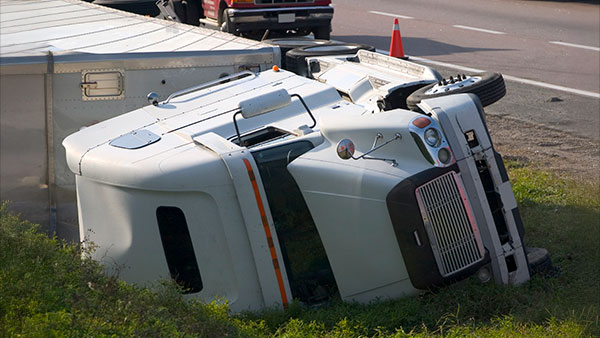
Recently, the U.S. Supreme Court decided to review whether brokers can be sued under state common law for negligently selecting a motor carrier in interstate truck transportation, or whether a federal statute preempts—in other words, supersedes and prevents—such negligence lawsuits.
The statute in question is the Federal Aviation Administration Authorization Act of 1994 (“F4A”), which, while not apparent from its name, generally prohibits states from regulating “a price, route, or service of” motor carriers and brokers, subject to certain exceptions including the allowance that states retain “safety regulatory authority … with respect to motor vehicles.” (49 U.S.C. § 14501(c)). Although the Supreme Court has affirmed that this statute does not preempt a negligence suit brought against a trucking company, the circuit courts of appeal are evenly divided over whether the “safety exemption” allows negligence suits against a broker. The four circuit courts of appeal that have addressed the issue have conflicting rulings (two on each side) about the meaning of the F4A, which has prompted the Supreme Court to consider the issue in order to resolve the circuit split.
Ultimately, the Supreme Court will decide whether brokers can be sued in state court and held liable for damages under negligent selection claims arising from truck accidents. This decision will have major ramifications for the transportation industry and public safety.
Who pays the gap?
While broker exposure to negligent selection claims is the legal issue before the Supreme Court, the fundamental underlying public policy question raised by this case is: who should bear the residual cost of truck accidents? There is strong agreement that when a motor carrier is at fault in an accident that results in injury or death, then the carrier should be the first in line to compensate the victim. There are good reasons for this: the carrier has the most control over the truck and driver and, if held liable, they are incentivized to operate safely.
Trucking, however, currently has an insurance problem. Carriers are required by federal law to carry a minimum of $750,000 in insurance (most carry $1 million). This amount was set in 1980 and would be about $4 million if indexed to inflation. The insurance minimum, however, was not indexed to anything, and accidents today quite often exceed $1 million in damages. So, what happens to these uncovered damages?
Consider an example. Suppose that a broker hires a small carrier with negligible assets to haul a load from one point to another. The carrier negligently crashes into a car, badly injuring two people. An impartial assessment estimates the damages due to medical expenses and lost earnings at $3 million. If the carrier’s insurance policy is limited to $1 million coverage, the carrier will likely go out of business and forfeit its negligible assets. Such an entity is referred to as “judgement-proof” because any damage award over $1 million simply goes unpaid. This leaves roughly $2 million in uncompensated damages, and the victims bear the residual cost of the accident.
There are two sides staked out in the case before the Supreme Court. One side of the argument (the “no liability” side), championed by trucking brokers, argues that brokers should have no liability for truck accidents in state courts under any circumstances—that F4A “preempts” state law. The other side (the “potential liability” side) argues that brokers can be jointly liable depending on the facts of the case.
To explore the ramifications of such joint liability, assume that upon investigation, more information comes to light. Suppose that the broker knew that the carrier had a history of drug infractions (For context, there were over 7,000 drug violations found in the Department of Transportation roadside inspections over the past two years). To make the example even more extreme, suppose that the broker knew that the driver had recently taken drugs, yet still hired them. Should the broker be liable? The no liability side argues that carrier safety is solely the responsibility of the Department of Transportation (DOT), and the broker should not be liable. The potential liability side argues that, in this case, the broker could be liable for the additional $2 million.
Let’s bring this example back to the original question—who should bear liability for truck accidents in order to attain the socially optimal level of highway safety? The no liability legal regime would result in the victims absorbing the residual $2 million. In the potential liability legal regime, the broker (or their insurance) would likely pay the $2 million. The potential liability side of the argument would lead to fewer drug-impaired truck drivers causing accidents on the country’s highways.
Principles
Three goals of accident law are to design a system that:
- minimizes the societal costs of accidents.
- cushions the impact of accident costs on individuals (i.e., spreads the cost).
- assigns the burden of accident costs on the best cost-avoider.
The first goal is to minimize the total cost of accidents, including prevention costs. For example, suppose that the annual expected accident cost of a truck on the road with no safety technology is $1,000. However, a carrier can install safety technology for $50 that will reduce the expected accident cost to $900 per year. From a total cost perspective, society is better off if the carrier installs the safety technology (expected accident costs would be $950 instead of $1,000). If the carrier does not bear the cost of the accidents, however, there is no incentive—indeed, a disincentive ($50)—to install the safety technology. Likewise, suppose that a broker can monitor the safety of carriers at low cost (for example, the DOT makes safety data available for free). If they are potentially liable for accidents, then the broker will monitor the carrier’s safety and refuse to arrange loads for unsafe carriers. If there is no liability, the broker has no incentive to monitor carrier safety.
The second goal is to spread the cost of accidents. In the no liability argument, residual costs from serious accidents fall on the victim(s). Trucking is a highly fragmented industry with hundreds of thousands of small carriers with insignificant assets. Given a serious accident, a carrier often goes bankrupt after the insurance pays the $1 million, leaving excess damages unpaid. In the potential liability argument, brokers (and broker insurance) are potential sources of compensation. Given that brokers can estimate the costs of accidents and can build that cost into their prices, this effectively spreads accident costs across the supply chain.
The third goal is to assign the burden of accident costs to the best cost-avoider. The carrier is the best cost-avoider since they control the truck and driver, can closely monitor safety, and have a direct incentive to avoid accidents. That is why, in my opinion, the best solution is to raise the minimum insurance coverage for small carriers whose insubstantial assets make them judgment-proof. Given the absence of legislation, however, this seems unlikely to happen. Who is the better cost-avoider, a broker or the general public? Brokers interact with carriers every day, have access to a plethora of data, and have expertise in assessing carriers. The general public, on the other hand, cannot reasonably be expected to assess the safety of the carriers sharing the roads alongside them. Moreover, brokers can hire and influence carriers, unlike the general public.
|
Principle |
No Liability |
Potential Liability |
|
Minimize the cost of accidents |
Brokers have no incentive to monitor carrier safety or encourage safe behavior from their carriers. |
Brokers are incentivized to monitor and select safer carriers and to encourage carriers to adopt safe behaviors. |
|
Spread the cost of accidents |
Residual accident costs are absorbed by the victim(s). |
Brokers can spread the cost of accidents in their prices. |
|
Assign costs to the best cost-avoider |
The general public is in a much worse position to monitor and assess carrier safety compared to brokers. |
Brokers are in a much better position to monitor and assess carrier safety than the general public. |
Conclusion
The Supreme Court’s decision will have major ramifications on the transportation industry and public safety. If the court decides that brokers are not subject to state negligence lawsuits because such claims are preempted (prevented) by the F4A, then I predict that:
- Nearly all loads will go through a brokerage of some sort. It is cheap and easy to set up a brokerage—there are roughly 30,000 of them in the U.S. If funneling a load through a broker eliminates any liability, then shippers will send all of their loads through a brokerage, even if it is simply a shell brokerage. For example, a large shipper could set up an in-house brokerage and operate the same as they do today, only routing each load through the brokerage.
- The industry will fragment even more, trending toward smaller and smaller carriers. Large carriers have millions of dollars in assets and often self-insure; this means that they must pay verdicts against them (i.e., they are not judgement-proof). In a regime of no liability except the minimum insurance coverage, any carrier able to pay more than the minimum is at a disadvantage compared to a carrier that carries minimum coverage.
- Road safety will deteriorate. Given less liability, the incentive to invest in safety will decrease, and those who hire carriers (i.e., those with the most influence on them) will have little reason to encourage safe behavior, much less pay for it.
Blanket liability protection for those parties who hire carriers will have serious consequences for public safety. The Supreme Court’s decision will have real-world impacts on the behavior of carriers and brokers and significantly impact public safety on the nation’s highways.
About the author
Alex Scott is an associate professor of supply chain management, Cheryl Massingale Business Faculty Scholar and the Gerald T. Niedert Professor in the Haslam College of Business at the University of Tennessee, Knoxville. His research focuses on supply chain policy, transportation sustainability and safety, and market dynamics and governance structures in the transportation industry.
SC
MR

More Brokers
 Explore
Topics
Procurement & Sourcing News
- Innovators Netstock, Pickle Robot win NextGen Solution Provider awards
- From salon to dock door: Repurposing scheduling software for inbound flow
- The biggest barrier to AI in supply chains isn’t technology
- Rebuilding a planning function around the physical world
- Why companies blame the wrong supplier … and miss the real failure
- NextGen Supply Chain Conference unveils agenda focused on AI, execution and the future of leadership
- More Procurement & Sourcing
Latest Procurement & Sourcing Resources
Subscribe

Supply Chain Management Review delivers the best industry content.

Editors’ Picks



